Showing posts with label yoga definition. Show all posts

Sunday, February 16, 2014

Sanskrit Word of the Week: Karma

Yesterday, I slipped and fell.  And at my age I don't bounce well.  Crash. Boom. Bam. Splat. Owwww.  Laid out flat at the bottom of the stairs.

After accessing the situation and determining I would live, my oldest son walked back up the stairs, singing, "Kar-ma, KARRR-maa."  My younger son showed a little more concern, "Should I call an ambulance or something?" he asked standing over me.

Earlier in the day, I had carried the clean laundry upstairs and put it away; only to find that my oldest son, when looking for a pair of socks to wear, had emptied the contents of his drawer onto his bedroom floor.  And then left for Taekwondo.  When he returned home, I calmly instructed him to not only hang up his uniform, but also to re-fold and put his socks and underwear back in the drawer.  When he finished, I checked to make sure the task was completed to my satisfaction.  After determining I could live with the results, I headed back down the stairs.  And then I fell.


My son implied my slipping was a result of the universe punishing me for wrongdoing--in this case for making him undo a mess he made.  He was wrong.  The universe was not punishing me by causing me to slip and fall.  However, the universe is punishing me for sins I committed years and years ago;  it's punishing me for disrespecting my own mother as a teenager--by providing me with my own disrespectful teenager.  In fact, it's downright LAUGHING at me.  Is it too late to apologize? 


KARMA IS A BITCH!
...Or is it?


Urban Dictionary defines Karma as:   The Buddhist belief that whatever you do comes back to you.  For example, if you do something good, something good will happen to you and vice versa.  Merriam-Webster and Dictionary.com define it essentially the same way.

Later that evening, we dropped both boys off at their Taekwondo school for a "lock-in" which coincided with Valentine's Day weekend.
Ten minutes after leaving them for our date night, my oldest son called, "Mom, I ripped my pants.  Can you bring me another pair?" 
"Sorry kiddo.  No can do," I sang, "We have res-ser-vaaaa-tions."

Yep.  Karma is a bitch!


Monday, January 20, 2014

Sanskrit Word of the Day: NAMASTE


NAMASTE written in Sanskrit


After our physical yoga practice, we relax on our backs, legs splayed apart, hands by our sides, palms face up as if ready to receive an offering.  Fingers retain their natural curl. We are in the most important pose of our practice, Savasana or Corpse Pose, where the breath and heart rate return to normal and our body and systems (digestive, immune, nervous, etc.) absorb the information from the stimulation of the poses we have just performed. After about ten minutes, we are instructed to begin moving fingers and toes and then told to turn and lie on our right side before returning to our comfortable seated position.  Eyes remain closed.  We bring our hands to heart center, anjali mudra, prayer positon.  Before sending us back into the world, my teacher prays:

May I take my yoga today with me in my heart, 
keeping it open to all situations I encounter.
May I take my yoga today with me in my mouth, 
speaking only my truth.
May I take my yoga today with me in my eyes, 
viewing all beings, 
 including myself, 
 with eyes that are filled with compassion.*


When she finishes speaking these lovely words, she honors the class by saying, "Namaste".  
"Namaste," we echo back bowing.

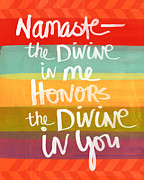
In Sanskrit, NAMA means "bow",  AS means "I", and TE means "you".  Therefore, NAMASTE literally translates to "I bow to you." However, it is more commonly translated as “The divine light in me honors the divine light in you."

In the West, we typically only speak the word, NAMASTE before and/or after a yoga practice.  Initiated by the teacher, NAMASTE is a symbol of gratitude and respect toward her students and her own teachers and in return invites the students to connect with their lineage.

For more information regarding the use of the word NAMASTE, check out this article in Yoga Journal or this article from the Chopra Center website.


NAMASTE as defined by Urban Dictionary:
an ancient Sanskrit greeting still in everyday use in India and especially on the trail in the Nepal Himalaya. Translated roughly, it means "I bow to the God within you", or "The Spirit within me salutes the Spirit in you" - a knowing that we are all made from the same One Divine Consciousness.
 NAMASTE as defined by dictionary.com:
a conventional Hindu expression on meeting or parting, used by the speaker usually while holding the palms together vertically in front of the bosom.
*My teacher, Talei, credits Vietnamese, Buddhist monk, Thich Nhat Hanh for the beautiful, inspiring prayer she delivers at the end of her classes with slight modifications made by her.

Monday, January 13, 2014

Sanskrit Word of the Day: Me and my OM


After leading us through a meditation to slow and deepen our breathing, we would be instructed to slowly rise into our comfortable seated posture from supta baddha konasana (reclining bound angle pose).  Eyes remained closed; our attention focused inward.   From there we would chant OM three times in unison.  On her instruction, we would inhale deeply together and on the exhale would pour our souls into a beautiful harmonized Oooooooommmmmmmmm.   

Inhale together again.  Oooooooooommmmmm.  

Inhale together again.  Ooooooooommmmmmm. 

Now we were ready to begin our physical practice.

The first time I attended her class, I felt intimidated.  I had never chanted OM before.  And while I didn’t know what it meant, my biggest concern was not whether or not it implied worship of a false idol, but rather could tone-deaf me chant on key.

The OM Symbol


In researching the meaning of OM, one of the best descriptions I found came from an article posted on the website theyogacommunity.com which states the following: 
Om is a sound and a symbol which is rich in meaning and depth.  It represents the divine in each of us, as well as our interconnectivity.  It reminds us that we have the ability to move past our physical and mental states of consciousness and connect with the divine – both in ourselves and others.  In its essence, Om represents the sound of divinity in all things in the past, present and future.
For the complete article, click here.

Just as the world and all it encompasses is too vast to completely comprehend, I still do not fully understand the meaning of OM.   But when performed, the release of energy into the universe and the peaceful feeling that reverberates back can only be described as magical.

A beautiful thing I discovered from my fear of chanting out of tune is that it cannot be done wrong.  The more air you breathe in, combined with the more you open your mouth and the louder you sing, the more magnificient the sound.  Do not hold back.  Let your Oooooommmmmm out! 


 OM as defined by Yoga Journal:

Om is a mantra, or vibration, that is traditionally chanted at the beginning and end of yoga sessions. It is said to be the sound of the universe. What does that mean?
Somehow the ancient yogis knew what scientists today are telling us—that the entire universe is moving. Nothing is ever solid or still. Everything that exists pulsates, creating a rhythmic vibration that the ancient yogis acknowledged with the sound of Om. We may not always be aware of this sound in our daily lives, but we can hear it in the rustling of the autumn leaves, the waves on the shore, the inside of a seashell.
Chanting Om allows us to recognize our experience as a reflection of how the whole universe moves—the setting sun, the rising moon, the ebb and flow of the tides, the beating of our hearts. As we chant Om, it takes us for a ride on this universal movement, through our breath, our awareness, and our physical energy, and we begin to sense a bigger connection that is both uplifting and soothing.

OM as defined by dictionary.com 
 noun:  a mantric word thought to be a complete expression of Brahman and interpreted as having three sounds representing Brahma or creation, Vishnu or preservation, and Siva or destruction, or as consisting of the same three sounds, representing waking, dreams, and deep sleep, along with the following silence, which is fulfillment.

OM as defined by Merriam-Webster 
 :  a mantra consisting of the sound \ˈōm\ and used in contemplation of ultimate reality.

Monday, January 6, 2014

Daily Dose of Gratitude


In yoga, we practice SANTOSA, which means contentment.  According to B.K.S. Iyengar, "Contentment has to be cultivated.  A mind that is not content, cannot concentrate."  The yogi feels the lack of nothing (does not want) and so he/she feels naturally content.  Contentment gives bliss.

 Fifteen years ago, my husband dragged me across the country kicking and screaming so he could continue his education at Arizona State University.  I am forever grateful to him for his foresight.  Since that time, life has been a giant roller coaster ride of adventure, with every curve just as exciting as the last.  It's easy to be grateful for the big, life-altering events.  The real challenge is finding gratitude in the mundane tasks of day to day life.

Today I am grateful for: 
    
  • After two weeks of sleeping in, I am grateful for an easy start to the day.  Both kids arose without complaint and with positive attitudes about returning to school.
  • I am grateful to have been up early today to witness the beautiful sunrise.
  • I am excited and grateful that school is delayed by two hours tomorrow due to cold temperatures.  I was beginning to feel left out by the excitement of the Blizzard of 2014 that my friends in the North are experiencing...plus I get one more day to sleep in!
  • I am grateful that my youngest son didn't whine about going to baseball practice tonight and I'm grateful that this is the last month of agility training until the season starts. 
  •  I am grateful to my husband for agreeing to pick said child up from baseball practice so I didn't have to go back out tonight.

Friday, January 3, 2014

Sanskrit Word of the Day: YOGA

Often when a person thinks of the word YOGA, they think of the physical practice and picture a yogi (someone who practices yoga) twisted in a pose that seems only a contortionist could perform.  There are many ways to practice yoga and many variations.  This entry is not intended to address the question, "What is Yoga?"  but rather define it and gives its actual translation from Sanskrit to English.  I will tackle, "What is Yoga?" in several future entries, as the subject matter is large and there are many perspectives to consider.  In the meantime, here is a great article from Yoga Journal which answers a lot of basic questions.  If you have any curiosity about Yoga, I highly recommend you check it out.


YOGA
as defined by B.K.S. Iyengar 
selected excerpts from Light on Yoga:

The word YOGA is derived from the Sanskrit root yuj  meaning to bind, join, attach and yoke, to direct and concentrate one's attention on, to use and apply.  It also means union or communion. 
Yoga is a timeless pragmatic science evolved over thousands of years dealing with the physical, moral, mental and spiritual well-being of man as a whole.  It is the true union of our will with the will of God.
Yoga is one of the six orthodox systems of Indian philosophy.  It was collated, coordinated and systematized by Patanjali in his classical work, the Yoga Sutras.  In Indian thought, everything is permeated by the Supreme Universal Spirit (God) of which the individual human spirit is a part.  The system of yoga is so called because it teaches the means by which the individual can be united to, or be in communion with God, and so secure liberation.

YOGA
as defined by Oxford Dictionary


noun:  a Hindu spiritual and ascetic discipline, a part of which, including breath control, simple meditation, and the adoption of specific bodily postures, is widely practiced for health and relaxation.

YOGA 
as defined by dictionary.com
1.  a school of Hindu philosophy advocating and prescribing a course of physical and mental disciplines for attaining liberation from the material world and union of the self with the Supreme Being or ultimate principle. 
2.  any of the methods or disciplines prescribed, especially a series of postures and breathing exercises practiced to achieve control of the body and mind, tranquility, etc.
3.  union of the self with the Supreme Being or ultimate principle.

and last but not least...